
What is Copper (XCU)?
XCU 2.68% todaySeptember 14, 2026 · Base unit: pound
Live Price
What is Copper (XCU)?
Copper (chemical symbol Cu, ticker XCU) is a reddish-orange base metal that has been used by civilizations for over 10,000 years. It is one of the few metals that occurs naturally in a directly usable form, and its exceptional electrical conductivity — second only to silver among pure metals — makes it indispensable in the modern world.
In global commodity markets, copper is primarily traded on two major exchanges: the COMEX (Commodity Exchange) in New York, where it is priced per pound (lb), and the London Metal Exchange (LME), where it is priced per metric ton. The price displayed on this page reflects the COMEX spot price per pound in USD, updated daily.
Copper is often called "Dr. Copper" by economists because its price is considered a reliable leading indicator of global economic health. When copper prices rise, it typically signals expanding industrial activity and economic growth worldwide.
- Symbol XCU
- Base Unit pound
- Today Open $6.54
- 24h High $6.56
- 24h Low $6.37
-
Electrical Wiring65% of all copper used globally
-
Plumbing & ConstructionPipes, roofing, fittings
-
Electric Vehicles (EVs)4× more copper than petrol cars
-
Renewable EnergySolar panels, wind turbines
-
Electronics & ChipsPCBs, motors, transformers
| From | To | Multiply By |
|---|---|---|
| 1 Pound (lb) | Kilogram (kg) | ÷ 2.20462 |
| 1 Pound (lb) | Gram (g) | × 453.592 |
| 1 Metric Ton | Pound (lb) | × 2,204.62 |
| 1 Metric Ton | Kilogram (kg) | × 1,000 |
- Open The price at which copper started trading at the beginning of today's session.
- High The highest price copper reached during the current trading day.
- Low The lowest price copper traded at during the current trading day.
- Prev Close The final settlement price of copper from the previous trading day.
- Change % Percentage change between today's current price and the previous closing price.
What Factors Affect the Copper Price?
Understanding the key drivers behind copper price movements helps investors, traders and industry professionals make informed decisions.
Copper supply is dominated by Chile, Peru, China and the Democratic Republic of Congo. Any disruption to mining operations — strikes, natural disasters, or government policy changes — can tighten supply and push prices higher. Demand is primarily driven by China, which consumes over 50% of global copper output.
China is the world's largest consumer of copper. Its manufacturing data, infrastructure spending, real estate activity, and electric vehicle production targets all have a direct and immediate impact on global copper prices. Positive Chinese economic data typically pushes copper prices up.
Since copper is priced in US dollars globally, there is an inverse relationship between the dollar's value and copper prices. When the USD strengthens, copper becomes more expensive for foreign buyers, which reduces demand and pushes prices lower — and vice versa.
A single electric vehicle (EV) contains 4× more copper than a traditional petrol car. As global EV adoption accelerates, demand for copper is expected to surge significantly. Many analysts consider this the most powerful long-term price driver for copper.
Solar farms, wind turbines and energy storage systems all require large amounts of copper for wiring and components. As the world transitions toward clean energy, copper demand is projected to double by 2035 according to various industry reports.
Higher interest rates from central banks like the US Federal Reserve tend to slow economic activity and reduce copper demand. Conversely, stimulus spending and infrastructure investment programs typically boost copper prices. Inflation expectations also influence commodity pricing.
Global Copper Market Overview
Top Copper Producing Countries
Global copper mining production is concentrated in a few key regions, making the market sensitive to political and environmental events in these areas.
Top Copper Consuming Countries
Copper demand is heavily skewed toward Asia, particularly China, which drives over half of global consumption through manufacturing and infrastructure investment.
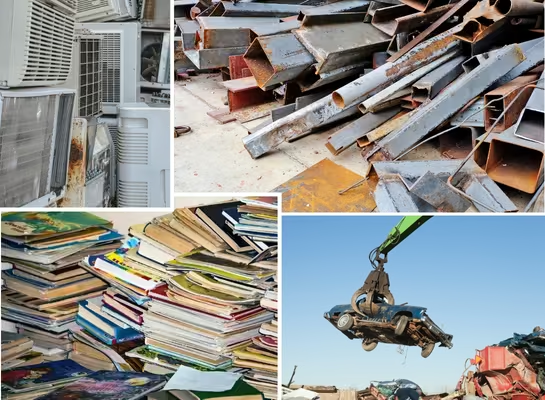
Copper Scrap Prices in Pakistan (PKR) - Karachi Market
Local copper scrap rates in Pakistan are influenced by international LME/COMEX prices, USD/PKR exchange rate, and local supply from construction, industrial and electrical sectors. Below are approximate indicative rates for common copper scrap grades available in Karachi and other major cities. Prices vary by grade, quantity and dealer. Always confirm current rates with your local kabari or scrap dealer.
| Copper Grade / Type | Local Name | Approx. Rate (PKR/kg) | Purity |
|---|---|---|---|
| Millberry / Bare Bright Copper | Misri / Armani Copper | ₨ 1,550 – 1,700 | 99%+ |
| Heavy Copper Wire | Mota Tamba | ₨ 1,400 – 1,550 | 95–98% |
| Copper Pipe / Tube Scrap | Tamba Nali | ₨ 1,350 – 1,500 | 90–95% |
| Mixed / Insulated Wire | Patli Taar | ₨ 900 – 1,150 | 60–80% |
| Copper Radiator Scrap | Radiator Tamba | ₨ 850 – 1,050 | 50–70% |
| Brass (Mixed Copper Alloy) | Peetal | ₨ 700 – 900 | Alloy (Cu+Zn) |
These are indicative rates only for Karachi market. Actual scrap prices vary daily with international copper rates, USD/PKR exchange rate, and local demand. Always contact your local scrap dealer (kabari wala) for exact current rates.
How Pakistan Copper Scrap Rates Are Calculated
Local scrap copper prices in Pakistan move with the international LME copper rate. The formula used by most dealers in Karachi, Lahore and Faisalabad is:
PKR Rate = (LME Rate ÷ 1000) × USD/PKR Rate × Purity% × Dealer Margin
For example, if LME copper is $9,500/ton and
USD/PKR is ₨280, then:
Per kg = (9,500 ÷ 1,000) × 280 = ₨2,660/kg (Grade A).
Local scrap rates will be lower depending on purity and dealer margin.
Use the Currency selector above to see today's copper price in PKR per kg automatically.
Copper vs Other Industrial Metals
| Metal | Symbol | Traded Per | Primary Use | vs Copper | |
|---|---|---|---|---|---|
| Copper | XCU | Pound / Metric Ton | Electrical, Construction, EVs | Current Page | |
| Nickel | NI | Metric Ton | Stainless Steel, EV Batteries | Higher price/ton | View → |
| Zinc | ZNC | Metric Ton | Galvanizing Steel | Lower price/ton | View → |
| Aluminium | ALU | Metric Ton | Aerospace, Packaging | Lower price/ton | View → |
Frequently Asked Questions - Copper Price
The copper spot price per pound is displayed at the top of this page and is updated daily. You can use the Currency selector to view the price in USD, PKR, EUR, GBP, AED, SAR or INR. Use the Unit selector to switch between pound, kilogram and gram pricing.
Copper is nicknamed "Dr. Copper" because its price movements are widely regarded as a reliable indicator of global economic health — almost as if it has a PhD in economics. Since copper is used in virtually every sector of the economy (construction, manufacturing, technology, transport), rising copper prices typically signal expanding economic activity, while falling prices may suggest a slowdown.
To see the copper price per kilogram, select Kilogram (kg) from the Unit dropdown at the top of this page. The price will automatically convert using the standard factor: 1 pound = 0.453592 kilograms. You can also switch currency at the same time to get the price in PKR, EUR or GBP per kilogram.
Approximately 65% of all copper produced globally is used in electrical wiring and power infrastructure. When copper prices rise significantly, the cost of installing or upgrading electrical systems — including transmission lines, transformers, motors and household wiring — increases. This can indirectly raise electricity infrastructure costs and construction expenses over time.
A standard electric vehicle uses approximately 80–100 kg of copper, which is 3–4 times more than a traditional internal combustion engine car. As global EV adoption accelerates, demand for copper is rising sharply. Industry analysts project that the EV and renewable energy transition could create a significant copper supply deficit by the late 2020s, which would be a major upward price driver.
COMEX (New York) trades copper futures in US cents per pound and is the primary benchmark for North American markets. The LME (London Metal Exchange) trades copper in USD per metric ton and is the global benchmark used in Europe and Asia. Both prices are closely correlated but may differ slightly due to regional supply/demand, trading hours and contract specifications.
Copper prices on this page are updated once per day, reflecting the latest daily closing or settlement price from global commodity markets. The chart allows you to view price history for the past 7, 15, 30 or 90 days. Currency exchange rates are also updated daily, so all converted prices remain accurate.
Copper prices in 2026 are being driven upward by accelerating electric vehicle (EV) adoption, large-scale renewable energy infrastructure investment, tightening mine supply from Chile and Peru, and continued infrastructure spending in China and the United States. The green energy transition requires significantly more copper per unit of energy capacity than traditional fossil fuel infrastructure, creating sustained long-term demand pressure.
This page does not provide financial advice. From an informational standpoint, many commodity analysts view copper as having strong long-term demand fundamentals due to its critical role in electrification and clean energy. However, copper prices can be highly volatile in the short term. Anyone considering copper as an investment should consult a licensed financial advisor and carefully assess their risk tolerance before making any decisions.
Copper scrap prices in Karachi fluctuate daily with international LME rates and the USD/PKR exchange rate. Millberry (Misri) copper typically trades around ₨1,550–1,700 per kg, while lower-grade insulated wire scrap may fetch ₨900–1,150 per kg. See the Copper Scrap Prices in Pakistan section on this page for a full breakdown by grade. Always verify current rates with your local scrap dealer as prices change daily.
Copper prices displayed on this page are sourced from global commodity markets and are indicative only. Prices are updated once daily and may not reflect real-time spot market movements.
This page is for informational purposes only and does not constitute financial or investment advice. Always verify with your broker or exchange before making any commodity trading decisions.